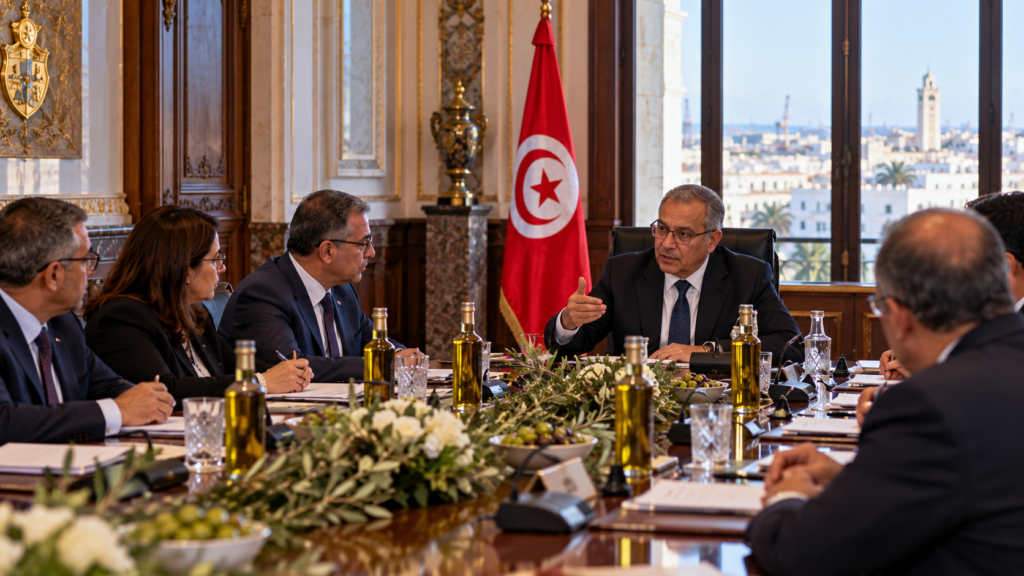
Tunisia’s government approved a 150-million-dinar support package on October 23, 2026, to help the National Olive Oil Office buy oil directly from producers and to raise export incentives for packaged olive oil ahead of the 2026-2027 season. The restricted ministerial council, chaired by Head of Government Sarra Zaafrani Zenzri at the Kasbah government palace, acted after a bumper 2025-2026 harvest pushed national production to 500,000 tonnes, 65% above the five-year average, while exports reached 399,000 tonnes by the end of September and are expected to hit 415,000 tonnes for the full season.
A 270 Million Dinar Financing Push for Farmers and Storage
The package channels 150 million dinars to the Office National de l’Huile (ONH) so it can purchase olive oil from producers and stabilize prices, funded jointly by public and private banks. Small farmers gain access to 20 million dinars in preferential credit through the Banque Tunisienne de Solidarite, with priority given to subsidies for mechanized harvesting equipment, while the draft 2027 finance bill proposes a further 100 million dinars in seasonal and investment credit for 2027-2030 through the Banque Nationale Agricole. The Central Bank of Tunisia will also work with commercial banks to reschedule small-farmer debt. On storage, the ONH can hold up to 60,000 tonnes of oil with sector operators for up to three months, and its own storage capacity rises to 100,000 tonnes from 90,000 tonnes last season, with storage and farmer premiums capped at 20 million dinars.
Export Incentives Target a Doubling of Packaged Oil Sales
Tunisia is raising the maritime transport premium for packaged olive oil from 50% to 60% through the export promotion fund, a measure the government plans to keep through 2027, and extending export incentives to containers between three and five liters. Minister of Agriculture Ezzeddine Ben Cheikh and ONH chief executive Moez Ben Amor presented figures showing packaged oil exports already grew 100% to 60,000 tonnes and organic oil exports rose 12% to 58,000 tonnes in the 2025-2026 season, with the government now targeting a doubling of both categories. Hotels and restaurants are being encouraged to serve branded Tunisian oil, and new training programs will cover pruning, disease control, mechanization and olive-waste (margine) recovery for farmers and mill operators. Buyers working with Tunisian suppliers should watch the packaged-export push closely, since it signals Tunisia’s intent to compete harder on branded and private-label oil rather than bulk shipments alone.
Sponsored Placement
Reach international olive oil buyers and importers. Advertise your business right here.
FAQ
How much is Tunisia investing to support its olive oil sector for 2026-2027? Tunisia’s government approved 150 million dinars for the National Olive Oil Office to buy oil from producers, plus 20 million dinars in preferential credit for small farmers and a planned 100 million dinars in financing for 2027-2030, announced on October 23, 2026.
Why is Tunisia raising its olive oil export subsidy? Tunisia is increasing the maritime transport premium for packaged olive oil from 50% to 60% to help exporters compete internationally and to support a government goal of doubling packaged and organic oil exports, which grew 100% and 12% respectively in the 2025-2026 season.
Source: La Presse de Tunisie
Sponsored Placement
Reach international olive oil buyers and importers. Advertise your business right here.