
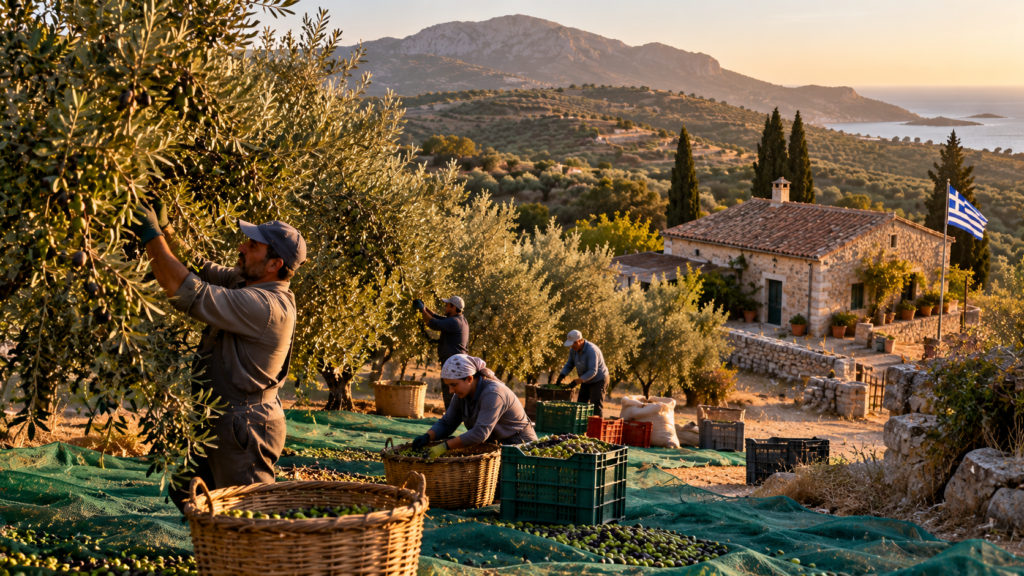
Greek olive oil production is expected to rebound sharply in the 2026/27 crop year, with industry estimates putting the national harvest at around 300,000 tons after last season’s disappointing, pest-hit crop — though persistent low prices near €4 per liter are tempering growers’ optimism.
A Bigger Harvest Across Key Growing Regions
If the forecast holds, Greece would record its largest olive oil harvest since 2022/23, when the country produced more than 330,000 metric tons. In the southern Peloponnese, trees are healthy and heavily laden with fruit: early estimates put Messenia’s output above 60,000 tons this crop year, with the Koroneiki variety — the region’s dominant cultivar — expected to be harvested starting in late October. On Crete, preliminary figures suggest production could reach double last year’s roughly 40,000-ton yield; the Zakros agricultural cooperative near Lasithi expects to exceed 1,000 tons, well above its recent annual average of around 300 tons, with harvesting running from early October through February. On the island of Lesbos, by contrast, heat stress has cut the expected crop roughly in half versus initial projections, even as the overall harvest still looks larger than last year’s.
Soft Prices Threaten to Undercut the Recovery
Origin prices remain the biggest concern for Greek producers. Carryover stock from last season is currently trading around €3.40 per liter, and new-crop extra virgin olive oil is expected to settle near €4 per liter — well below the €5 level growers say is needed to stay profitable. Producers in Messenia and Crete point to a key external factor: Spain, the world’s largest olive oil producer, is forecasting a 23 percent jump in output for 2026/27, and an abundant Spanish harvest typically pulls Mediterranean-wide wholesale prices down with it. In Laconia, where last year’s crop reached only about half of the region’s 30,000-ton capacity, one producer association warned that continued prices below €5 per liter could push growers to abandon groves altogether. Further north, in Stylida, producers have staged protests over low prices and olive fruit fly damage, calling on authorities to guarantee a minimum price that covers production costs. For international buyers who also source directly from Tunisian olive oil exporters, this matters: as Spain and now Greece push more volume onto the market, the resulting pressure on Mediterranean benchmark prices typically feeds into more competitive FOB offers out of Tunisia as well, since Tunisian export pricing tends to track the broader regional trend.
Sponsored Placement
Reach international olive oil buyers and importers. Advertise your business right here.
FAQ
How much olive oil will Greece produce in 2026/27? Industry estimates point to around 300,000 tons of Greek olive oil in the 2026/27 crop year, which would be the country’s largest harvest since 2022/23, when production topped 330,000 metric tons.
Why are Greek olive oil prices staying low despite a bigger expected harvest? Origin prices are hovering near €4 per liter for new-crop extra virgin olive oil, well below the €5 level producers consider profitable, largely because Spain’s forecast 23 percent production increase is expected to pull Mediterranean-wide wholesale prices lower.
Source: Olive Oil Times
Sponsored Placement
Reach international olive oil buyers and importers. Advertise your business right here.