
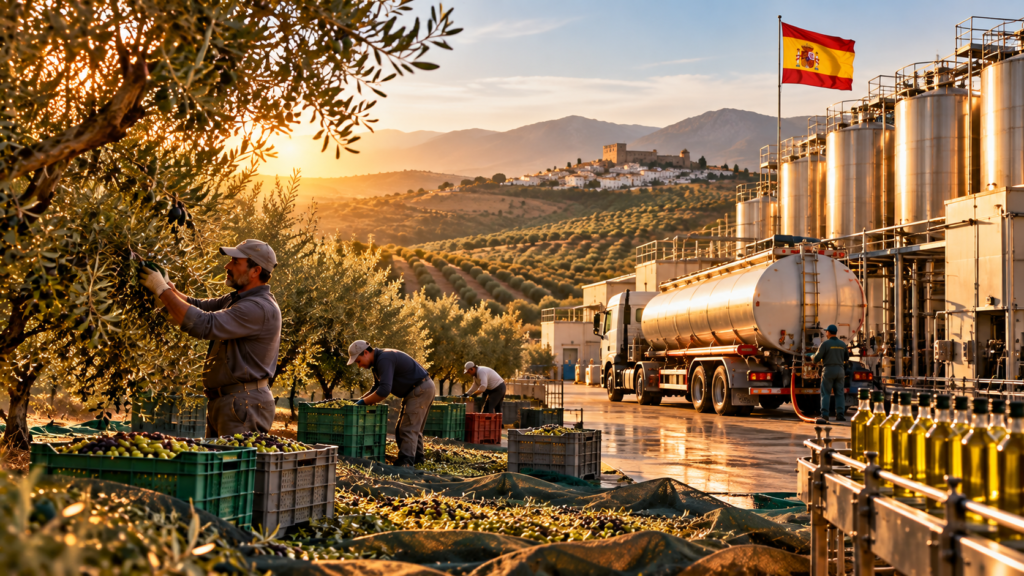
Spain’s Ministry of Agriculture expects the country’s olive oil production to jump 23% in the 2026/27 crop year, to 1.603 million metric tons, a rebound large enough that regulators are now weighing whether to pull oil off the market to prevent oversupply. The forecast, described by the ministry as “medium-high,” would mark a sharp recovery from the roughly 1.298 million tons produced in 2025/26, when adverse weather cut output below initial estimates. Favorable spring rainfall and mild temperatures across Spain’s main growing regions underpinned much of the rebound, though officials caution that summer heat already stressed rainfed groves and that the final figure will depend on conditions through the rest of the harvest.
Andalusia and Jaén Carry the Rebound
Andalusia, the world’s largest olive oil-producing region, is expected to account for 1.261 million tons of Spain’s crop — nearly four-fifths of the national total. Within Andalusia, Jaén province alone is forecast to produce 575,000 tons, equivalent to 36% of all Spanish olive oil and 45.6% of the region’s output, followed by Córdoba at 339,700 tons and Seville at 142,000 tons. Agriculture Minister Luis Planas said the forecast “provides a guarantee of supply and stability for the domestic market and our exports,” though farm groups including COAG Andalucía and UPA Andalucía have warned that persistent dry weather in rainfed groves could still pull the final number below the current estimate.
Spain Weighs Pulling Oil From the Market
Spain still held more than 475,000 tons of olive oil in storage at the end of August 2026, and farm organizations estimate carryover stocks entering the new season at between 350,000 and 374,000 tons. Combined with the new harvest, that could put close to 2 million tons of Spanish olive oil on the market before any imports are counted — enough, some producer groups argue, to trigger a market-regulation mechanism under Article 167 bis of the EU’s Common Market Organization rules, which allows oil to be temporarily withdrawn from the market or redirected to non-food uses if opening stocks plus forecast production reach 120% of the past six years’ average. The Spanish government has said it will review final regional estimates and stock figures in October and decide by the first half of November whether to activate the mechanism. For buyers sourcing Tunisian olive oil, that decision is worth watching closely: Spain buys close to a third of Tunisia’s olive oil exports by volume, and a larger or smaller effective Spanish supply typically moves prices across the whole Mediterranean market, Tunisian oil included.
Sponsored Placement
Reach international olive oil buyers and importers. Advertise your business right here.
FAQ
How much will Spain’s olive oil production grow in 2026/27? Spain’s Ministry of Agriculture forecasts 2026/27 production at 1.603 million metric tons, a 23% increase over the roughly 1.298 million tons produced in 2025/26, with Andalusia expected to supply nearly four-fifths of the total.
What is the EU mechanism that could pull Spanish olive oil off the market? Under Article 167 bis of the EU’s Common Market Organization rules, Spain can temporarily withdraw olive oil from sale, or divert it to non-food uses, if opening stocks plus forecast production reach 120% of the average level recorded over the past six crop years; Spain’s government expects to decide by mid-November 2026.
Source: Olive Oil Times
Sponsored Placement
Reach international olive oil buyers and importers. Advertise your business right here.