
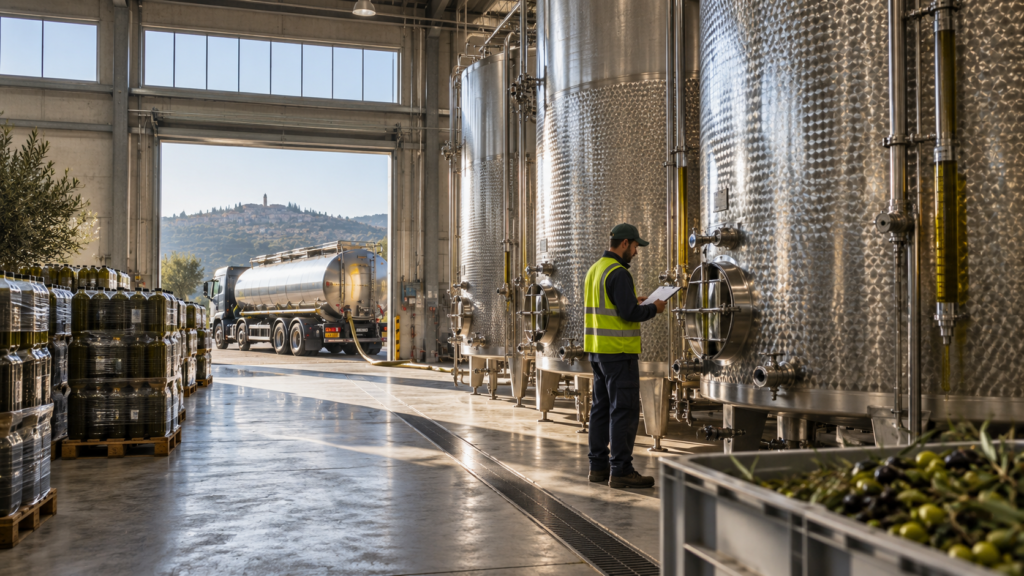
Italy now imports more olive oil than it keeps for its own domestic market, according to two decades of data released this month by Italy’s national statistics agency, ISTAT. The figures show a steady structural shift: as Italian olive oil production has fallen, imports and exports have both climbed, turning the country from a production powerhouse into what analysts increasingly describe as a global trade hub for olive oil.
Two Decades of Falling Production, Rising Trade
Between 2006 and 2025, Italian olive oil production dropped from 603 million liters to 379 million liters, a decline of 38 percent, according to ISTAT. Over the same period, imports rose 44 percent, from 392 million to 565 million liters, while exports increased 43 percent, from 209 million to 298 million liters. By 2025, only 81 million liters of Italian-produced olive oil were destined for Italy’s own market, down 79 percent from 394 million liters in 2006 — meaning exports now account for nearly 79 percent of national production. ISTAT attributed the long-term production decline to climatic, phytosanitary and management pressures on Italian groves: while cultivated area shrank just 1.4 percent over the two decades, average yields fell 26.1 percent, from 30.7 to 22.7 quintals per hectare.
A New Five-Year Plan, and Full Storage Tanks Ahead of Harvest
The ISTAT figures follow the formal adoption of Italy’s 2026–2030 Olive Oil Plan, drawn up with the country’s main producer, grower and miller associations to reverse the production decline, curb grove abandonment and modernize orchards. Agriculture Undersecretary Patrizio La Pietra said years of fragmented production, climate pressure and insufficient planning had “progressively eroded the sector’s productive potential.” The plan arrives as Italy heads into a new harvest with unusually high unsold inventories still sitting in storage tanks, and as the sector grows more exposed to swings in its main export markets — the United States alone accounted for 38 percent of the value of all European Union olive oil exports in 2025.
For buyers who have long assumed a bottle labeled “Italian” means olives grown and pressed entirely in Italy, this shift toward heavier imports and blending makes clear, single-origin traceability more valuable than ever. Tunisia, which closed its own 2025/26 season as the world’s second-largest olive oil producer, offers buyers a direct chain of custody back to the grove — an increasingly rare guarantee as Mediterranean supply chains grow more blended. Buyers working with our supplier network can request full origin documentation on every shipment.
Sponsored Placement
Reach international olive oil buyers and importers. Advertise your business right here.
FAQ
How much has Italy’s olive oil production fallen since 2006?
According to ISTAT, Italian olive oil production fell from 603 million liters in 2006 to 379 million liters in 2025, a decline of 38 percent, even though cultivated olive area shrank by only 1.4 percent.
Does Italy still produce most of the olive oil sold as “Italian”?
Not for its own market alone: by 2025 just 81 million liters of Italian-produced olive oil stayed in Italy, down 79 percent from 2006, while imports rose 44 percent to 565 million liters to help meet demand and supply blending and re-export.
Source: Olive Oil Times
Sponsored Placement
Reach international olive oil buyers and importers. Advertise your business right here.