
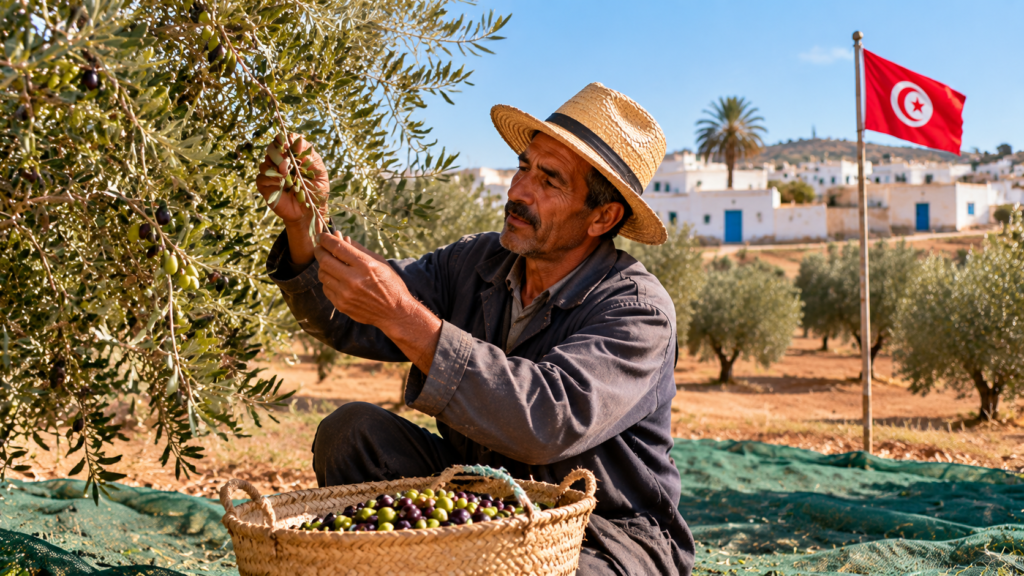
Tunisia’s olive harvest for the 2026/27 season is expected to fall by 30% to as much as 50% from last year’s record crop, according to multiple Tunisian industry groups, who point to a natural rest cycle in the country’s olive trees rather than drought or weather damage.
Why Industry Groups Expect a Much Smaller Crop
Tunisia’s National Chamber of Olive Producers, led by president Najah Saïdi Hamed, forecasts around 300,000 tonnes for 2026/27 — a roughly 40% decline from the 2025/26 season’s record 500,000 tonnes. The farmers’ union Synagri, through its president Midani Dhaoui, puts the figure even lower, at 200,000 to 250,000 tonnes, or nearly half of last season’s crop. A representative of the Tunisian Olive Growers’ Union separately estimates a 30% to 40% drop. Tunisia’s Ministry of Agriculture has not yet published an official national figure, so the exact number remains unsettled, but every industry voice points the same way: sharply down from last year.
A Natural Dip, Not a Drought
Olive trees naturally swing between a heavy “on” year and a lighter “off” year, and 2025/26 was an exceptionally strong on-year for Tunisia, with a record harvest validated by the International Olive Council. Synagri’s Dhaoui also pointed to the unusually late 2025/26 harvest itself, which kept trees working longer than normal and left them less time to recover before this season’s flowering. Early regional figures echo the national trend: Manouba governorate expects around 14,000 tonnes of olive oil, down about 32% from more than 20,750 tonnes last season, while Sidi Bouzid, one of Tunisia’s largest olive-growing regions, is tracking toward roughly 350,000 tonnes of olives, down from about 500,000 tonnes a year earlier. For buyers sourcing bulk olive oil from Tunisia, a lighter 2026/27 crop is a reason to lock in supply agreements with vetted Tunisian suppliers early this season, since tighter domestic volumes have historically firmed up prices even while last year’s record harvest continues shipping out under existing export contracts.
Sponsored Placement
Reach international olive oil buyers and importers. Advertise your business right here.
FAQ
How much will Tunisia’s olive harvest fall in 2026/27? Tunisian industry estimates range from a 30% to roughly 50% drop compared with the 2025/26 season’s record 500,000-tonne harvest, with the farmers’ union Synagri forecasting 200,000 to 250,000 tonnes and the National Chamber of Olive Producers forecasting about 300,000 tonnes.
Why is Tunisia’s 2026/27 olive harvest expected to be so much smaller? Industry officials attribute the drop mainly to the natural alternate-bearing cycle of olive trees following last season’s record crop, compounded by 2025/26’s unusually late harvest, which left trees less time to recover — not to drought or poor weather this year.
Source: Wikifarmer
Sponsored Placement
Reach international olive oil buyers and importers. Advertise your business right here.