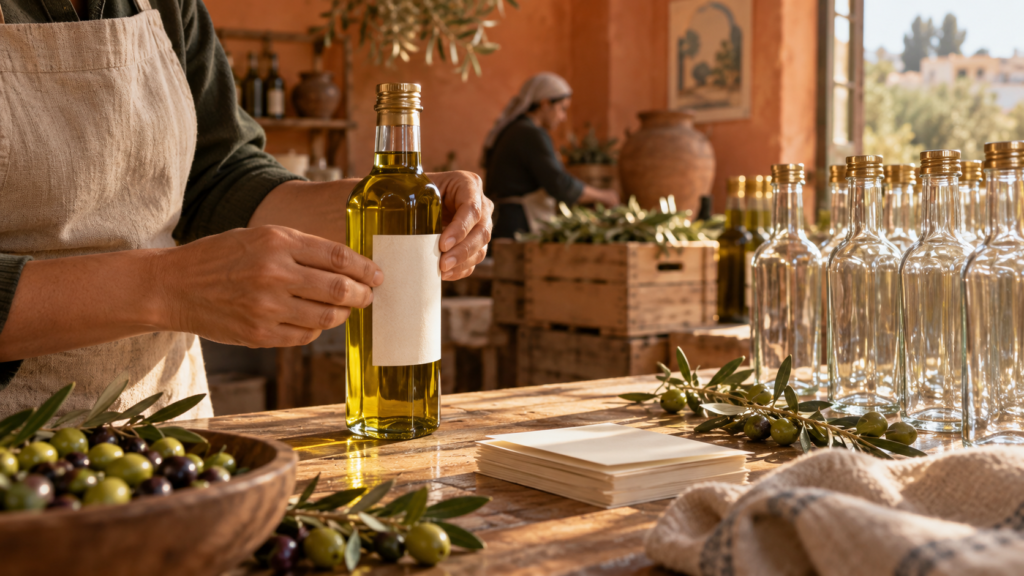
Tunisia’s bottled olive oil exports climbed to roughly 14% of total shipments during the 2025/2026 season, up from just 8 to 9% a few years earlier, but the country is still losing out on the bulk of the value its olive oil generates abroad, agricultural policy expert Faouzi Zayani said on Tunisian radio station Diwan FM on September 13, 2026.
Zayani’s comments came in response to a recent CNN report, relayed by Tunisian outlet Business News, that highlighted a longstanding paradox: Tunisia ranks among the world’s largest olive oil producers, yet its name rarely appears on the bottles that reach supermarket shelves in Europe or North America.
Bulk Exports Still Dominate, and the Value Stays Abroad
According to figures cited in the CNN report, 86% of Tunisia’s olive oil exports during the 2025/2026 campaign were shipped in bulk, mostly to Spain, Italy and the United States. Once it arrives, that oil is frequently repackaged, blended with other origins, or sold under foreign private labels that make no clear reference to Tunisia. European Union rules permit broad origin labeling such as “blend of olive oils from the European Union and outside the European Union,” which can further obscure a bottle’s true source.
Tunisian-American economist Fadhel Kaboub, also cited by CNN, argued that the real contest is not about growing olives but about controlling the value chain, from bottling and branding to distribution and shelf placement, the stages where most of the profit is actually made. International buyers increasingly want to skip that opaque chain altogether and source directly from vetted Tunisian producers and exporters who can document the oil’s true origin from harvest to shipment.
Protected Origin Labels and a Push Into New Markets
Zayani argued that the path forward runs through geographic indications and stronger regional branding. He pointed to early appellation-style projects in Teboursouk, Ghomrassen and Meknassi as examples of how Tunisia could market its oils by terroir rather than as one uniform commodity, estimating the country could eventually market 60 to 70 distinct region-specific oils, similar to how France markets multiple olive oil appellations despite producing far less than Tunisia.
Sponsored Placement
Reach international olive oil buyers and importers. Advertise your business right here.
He also called for a permanent Tunisian commercial presence in growing markets such as China, India, Indonesia and Nigeria, rather than one-off appearances at international trade fairs, with the state providing the legal and logistical support exporters need to sustain it. Zayani announced that a dedicated event on the valorization, promotion and packaging of Tunisian olive oil will be held in Sfax from October 22 to 26, 2026, including a session on how appellations of origin can support marketing efforts.
FAQ
What share of Tunisia’s olive oil exports are bottled rather than sold in bulk?
About 14% of Tunisia’s olive oil exports were bottled during the 2025/2026 season, up from roughly 8 to 9% in previous years, according to agricultural policy expert Faouzi Zayani.
Why doesn’t Tunisian olive oil usually carry the country’s name on foreign shelves?
Because most Tunisian olive oil is exported in bulk, mainly to Spain, Italy and the United States, where it is often repackaged, blended with other origins, or sold under foreign brands without a clear reference to its Tunisian source.
Source: Business News, September 13, 2026 and Business News, September 12, 2026
Sponsored Placement
Reach international olive oil buyers and importers. Advertise your business right here.