Italy’s National Research Council (CNR) has opened Domus Olear∑, one of the world’s largest olive tree gene banks, in Gubbio, Umbria — a living collection of more than 800 genetically distinct olive varieties and wild relatives gathered from more than 30 countries to protect the crop’s genetic diversity against disease, climate change, and extinction. Built by the CNR’s Institute of Biosciences and Bioresources (CNR-IBBR) after four years of DNA analysis on more than 10,000 olive samples worldwide, the 10-hectare collection formally opens to the public on September 18, 2026, and has already been registered with the United Nations Food and Agriculture Organization under the code ITA481.
Why a Gene Bank Matters for the World’s Olive Oil Supply
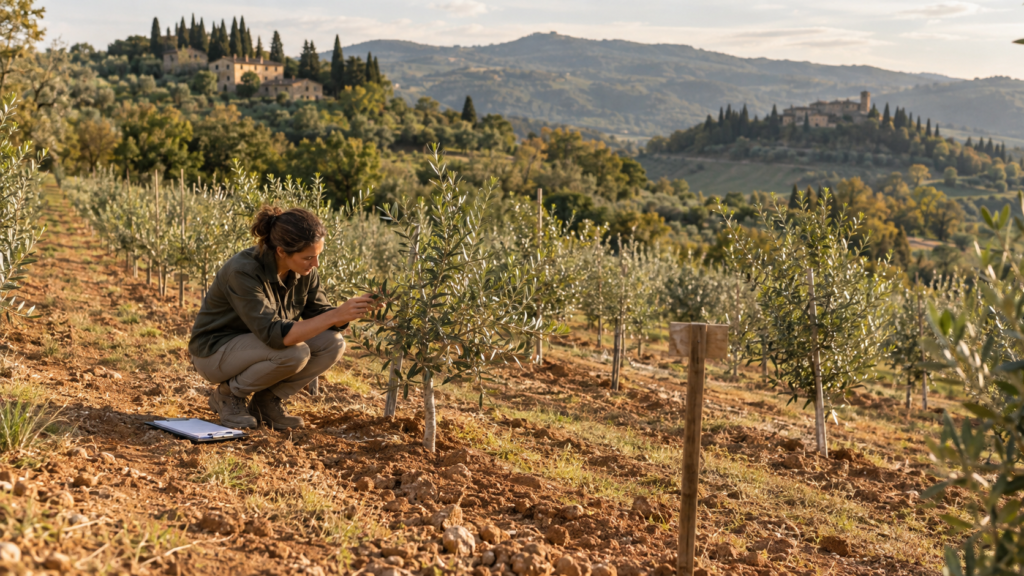
Researchers analyzed more than 10,000 olive DNA profiles and identified roughly 3,000 unique genotypes worldwide — a first real attempt to put a number on how many distinct olive varieties actually exist, rather than relying on local names that often overlap or mislead. Of those, CNR-IBBR has so far propagated 454 genetically distinct cultivars from 27 countries by grafting, alongside more than 400 wild olive genotypes and subspecies, for a total of over 800 unique accessions planted at the Di Murro family farm in Gubbio. The collection includes rare wild subspecies from the Canary Islands, Madeira, Morocco, the Sahara, and as far as East Africa and Iran — genetic material researchers say could hold the resistance traits olive growers will need as droughts, pests like Xylella fastidiosa, and shifting growing seasons put pressure on orchards across the Mediterranean.
One Name, Many Trees: The Confusion Around Olive Varieties
A striking finding from the DNA work is how unreliable variety names can be. Researchers found the Frantoio cultivar carries more than 20 different local names across Italy alone, while, in the opposite direction, names like Rosciola, Tonda, Ogliarola, Mission, and Chemlali are used in different regions for trees whose DNA sequences turn out to be completely different from one another. For buyers sourcing Tunisian olive oil, that second point is worth remembering: Chemlali is one of Tunisia’s principal cultivars alongside Chetoui, Oueslati, and Zarrazi, and a shared variety name elsewhere in the Mediterranean does not mean the same genetic tree, flavor profile, or oil chemistry — another reason to buy from verified Tunisian suppliers who can trace the trees an oil actually comes from.
Sponsored Placement
Reach international olive oil buyers and importers. Advertise your business right here.
FAQ
What is Domus Olear∑? Domus Olear∑ is a new olive tree gene bank built by Italy’s CNR-IBBR research institute in Gubbio, Umbria, holding more than 800 genetically distinct cultivated and wild olive varieties from over 30 countries to protect global olive biodiversity.
Why do olive variety names cause confusion? Because the same name, like Chemlali, Rosciola, or Tonda, is sometimes used in different regions for genetically unrelated olive trees, while a single variety like Frantoio can carry more than 20 different local names, so DNA testing rather than naming is now used to tell true varieties apart.
Source: Olive Oil Times
Sponsored Placement
Reach international olive oil buyers and importers. Advertise your business right here.