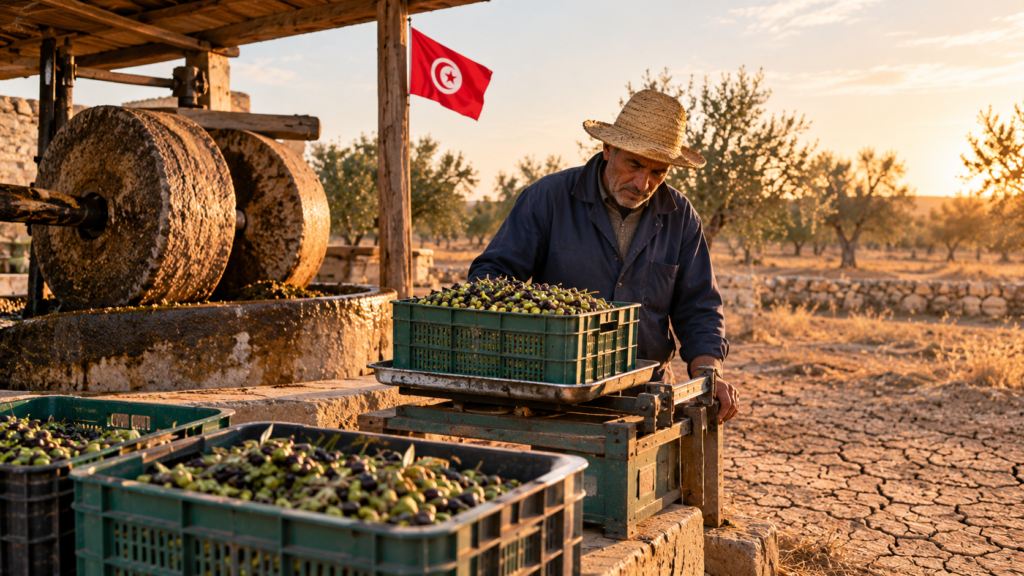
Tunisia’s olive oil council is forecasting a roughly 40% drop in the country’s 2026/2027 olive harvest, as drought and unusually high temperatures cut into yields even as the new season’s picking calendar gets underway.
Al-Moldi Ramadani, a member of Tunisia’s National Olive Oil Council, told local media this week that national olive oil production for the coming season is estimated at around 300,000 tons, with the irrigated growing regions of Kairouan and Sidi Bouzid showing noticeably more stable yields than rain-fed areas hit hardest by the dry, hot conditions.
A Smaller Crop, Driven by Drought
The 40% decline follows a pattern seen across much of Tunisia’s rain-fed olive belt this year, where reduced rainfall and sustained heat have left trees producing fewer, smaller olives with lower oil content. Current extraction ratios reflect the strain: presses report needing between 9 and 12 kilograms of olives to produce a single liter of oil, well above the ratio seen in a strong harvest year. Irrigated zones like Kairouan and Sidi Bouzid are proving the exception, with steadier tree health cushioning the overall national estimate of around 300,000 tons.
Harvest Calendar and Rising Press Prices
Kairouan, one of Tunisia’s largest olive-growing governorates, has set October 26, 2026 as its official start date for the harvest, while picking has already begun earlier in Medenine and parts of Sidi Bouzid. Council members expect the broader harvest to properly open in early November, once more fruit reaches full ripeness across the country’s groves. At the mills, farmers are currently selling raw olives for between 9 and 10 Tunisian dinars per kilogram, which is translating into a final oil cost of roughly 12 to 13 dinars per liter once pressing and agency fees are factored in. Industry figures are calling for markets able to absorb this year’s smaller, costlier crop while still covering farmers’ production expenses.
Sponsored Placement
Reach international olive oil buyers and importers. Advertise your business right here.
For buyers working with Tunisian olive oil suppliers, this season’s tighter supply and higher raw-material costs make early contracting and sourcing in bulk from better-irrigated regions like Kairouan and Sidi Bouzid a safer way to lock in consistent volumes before prices climb further as the harvest progresses.
FAQ
How much will Tunisia’s olive harvest drop in 2026? Tunisia’s National Olive Oil Council forecasts the 2026/2027 olive harvest will fall by roughly 40% compared to the previous season because of drought and high temperatures, with national oil production estimated at around 300,000 tons.
When does the 2026 olive harvest start in Tunisia? Kairouan has set October 26, 2026 as its official harvest start date, following earlier picking in Medenine and Sidi Bouzid, though the main national harvest is expected to begin in early November as more olives ripen.
Source: Tuniscope
Sponsored Placement
Reach international olive oil buyers and importers. Advertise your business right here.