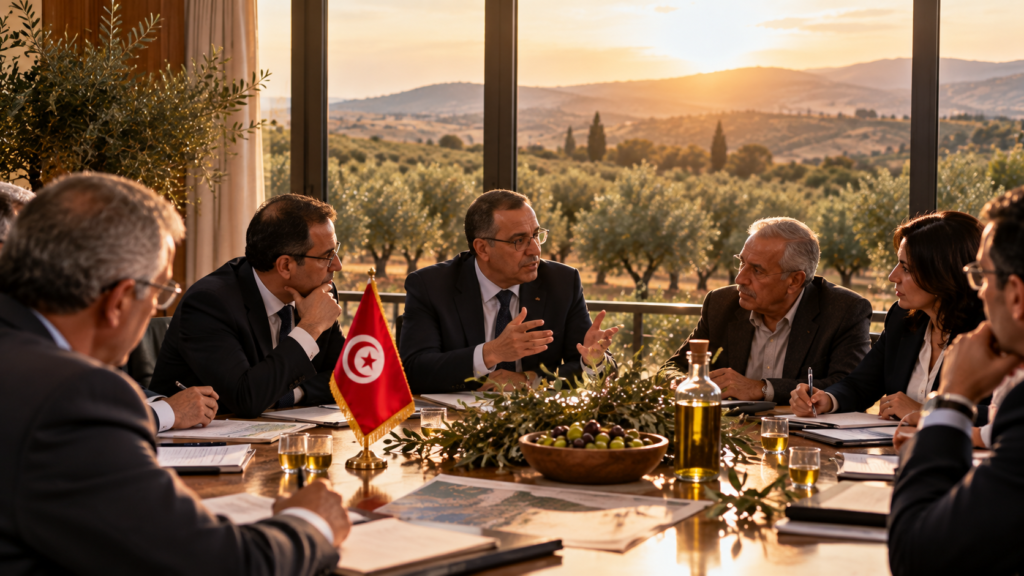
Tunisia’s Ministry of Agriculture, Water Resources and Fisheries opened a national public-private dialogue workshop on September 24, 2026, bringing together government bodies, professional organizations, international institutions and industry experts to build an integrated strategy for the country’s olive oil sector through the year 2050.
Minister Ezzedine Ben Cheikh launched the “National Public-Private Dialogue on the Development, Valorization and Sustainability of the Olive Oil System in Tunisia,” organized by the General Directorate of Agricultural Production with coordination from relevant bodies and funding from the Partnership Agreement Support Program Management Unit (UGP3A) and the World Bank. Participants worked to diagnose the sector’s challenges, set priorities and draft practical proposals to strengthen its sustainability and competitiveness.
Why Tunisia’s Olive Oil Sector Needs a Long-Term Strategy
The olive oil system carries strategic weight in Tunisia’s agricultural economy. Olive groves now cover more than 2.1 million hectares, roughly 42% of the country’s arable farmland, and include over 147 million olive trees. The sector is linked to around 309,000 farming operations, plus processing, storage, packaging, marketing and refining activities. Olive oil contributes about 10% of Tunisia’s agricultural production value and close to 44% of total agricultural exports, with average annual exports over the past five years at around 212,000 tons.
A Record Season Raises the Stakes on Planning
The 2025-2026 season saw a sharp jump in production, reaching roughly 500,000 tons compared to 340,000 tons the previous season, an increase of nearly 47%. Exports over the first ten months of the season rose 50.8% to about 381,200 tons, while exports of organic olive oil reached around 53,000 tons. Minister Ben Cheikh said the figures confirm the sector’s economic weight but also underline the need to keep raising the product’s added value, strengthen its competitiveness and improve its positioning in global markets, particularly through better quality control, market diversification and the development of packaged and higher-value products. The workshop’s discussions were organized around four themes: olive production and climate resilience, processing and quality/waste valorization, markets and positioning for Tunisian olive oil, and governance and public-private partnership. The ministry is also preparing a dedicated olive oil development plan within Tunisia’s 2026-2030 agriculture and fisheries development strategy.
Sponsored Placement
Reach international olive oil buyers and importers. Advertise your business right here.
For international buyers sourcing olive oil from Tunisia, this kind of coordinated, long-horizon planning is worth watching: it points to continued state investment in quality, traceability and export infrastructure that can shape supply reliability and product standards in the years ahead.
FAQ
What is the goal of Tunisia’s national olive oil dialogue launched in September 2026?
The workshop, opened on September 24, 2026 by Agriculture Minister Ezzedine Ben Cheikh, aims to build an integrated vision for developing, valorizing and sustaining Tunisia’s olive oil sector through 2050, covering production, processing, markets and governance.
How large is Tunisia’s olive oil industry?
Tunisia’s olive groves cover more than 2.1 million hectares, about 42% of arable farmland, with over 147 million trees linked to roughly 309,000 farms. The sector provides about 10% of agricultural production value and 44% of Tunisia’s agricultural exports.
Source: AgroVisium
Sponsored Placement
Reach international olive oil buyers and importers. Advertise your business right here.