
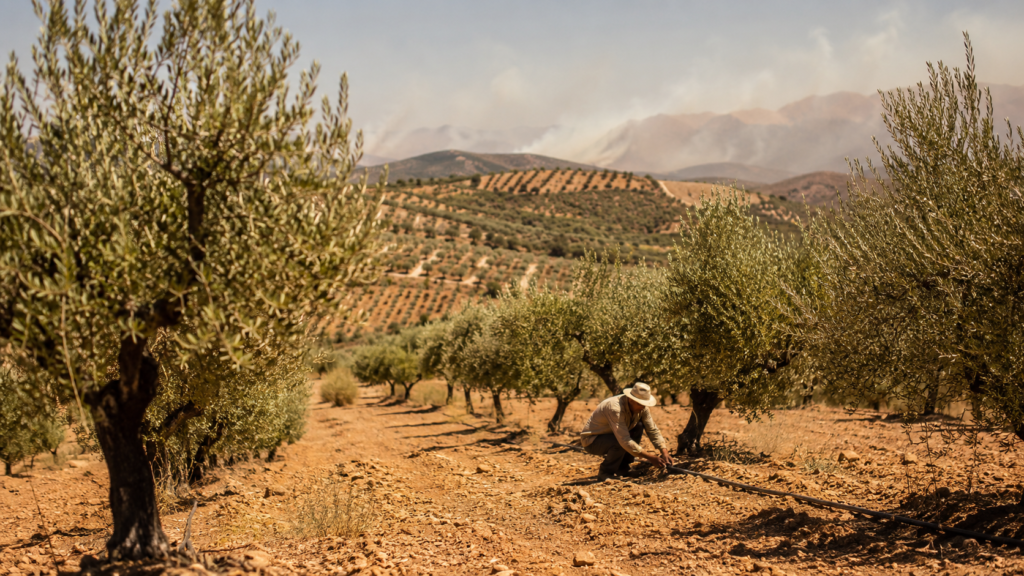
Prolonged heat, drought and wildfires are threatening olive groves across Europe ahead of the 2026/27 harvest, with growers from Turkey to Croatia reporting reduced fruit set, pest outbreaks and fire damage this summer. Growers and agronomists interviewed by Olive Oil Times described unusually hot, dry conditions since June across Turkey, Greece, Italy, Croatia, Hungary and even Britain, disrupting olive development just months before picking begins.
Heat and Drought Squeeze Traditional Producers
In Turkey’s Manisa-Köprübaşı region, temperatures reached 35°C to 38°C between June and August with almost no rainfall, forcing growers like Zagoda Olive Oil’s Ismail Sahin to rely on regular irrigation. Sahin expects yields roughly 35 percent higher than last season’s weak harvest, but is skeptical of press claims that Turkey will set a production record. In Greece’s Chalkidiki peninsula, Konstantinos Vlavis, head of the local agricultural association of Metaggitsi, said drought and sporadic rain caused fruit to drop early and fueled an outbreak of the olive borer, leaving the region on track for a below-average crop despite a wet winter. Wildfires in late July and August also damaged groves in Viotia, Attica, Chalkidiki and Crete.
Pests, Wildfires and a New Italian Strategy
In Italy, agronomist Giovanni Minuto of the CeRSAA research center said a rapid rise in temperatures during June and July depleted soil moisture and disrupted the normal biological rhythm of the olive fruit fly, which “literally exploded” in mid-July 2026. In response, the Italian government has adopted the Olive Oil Plan 2026-2030 to modernize processing facilities and strengthen supply-chain competitiveness. In Croatia, a wildfire near the Dalmatian port of Omiš burned decades-old olive groves and vineyards in mid-August, while producers in Istria and emerging growers in Hungary and Britain described similarly dry, hot conditions forcing extra irrigation of young trees.
For international buyers used to sourcing from traditional Mediterranean suppliers, the pattern is a reminder to diversify: Tunisia closed its own 2025/26 campaign as the world’s second-largest olive oil producer, giving buyers a proven, high-volume source when yields further north come under pressure.
Sponsored Placement
Reach international olive oil buyers and importers. Advertise your business right here.
FAQ
Why is Europe’s olive harvest at risk in 2026? Prolonged heat, drought and an unusually early outbreak of the olive fruit fly have hit producing regions in Turkey, Greece, Italy and Croatia since June 2026, while wildfires have destroyed groves in Greece and Croatia ahead of the 2026/27 harvest.
Which European countries are most affected by the 2026 olive harvest problems? Turkey, Greece, Italy and Croatia have reported the most significant weather-related stress, with Greece’s Chalkidiki peninsula and Croatia’s Dalmatian coast also suffering wildfire damage to established olive groves.
Source: Olive Oil Times
Sponsored Placement
Reach international olive oil buyers and importers. Advertise your business right here.