
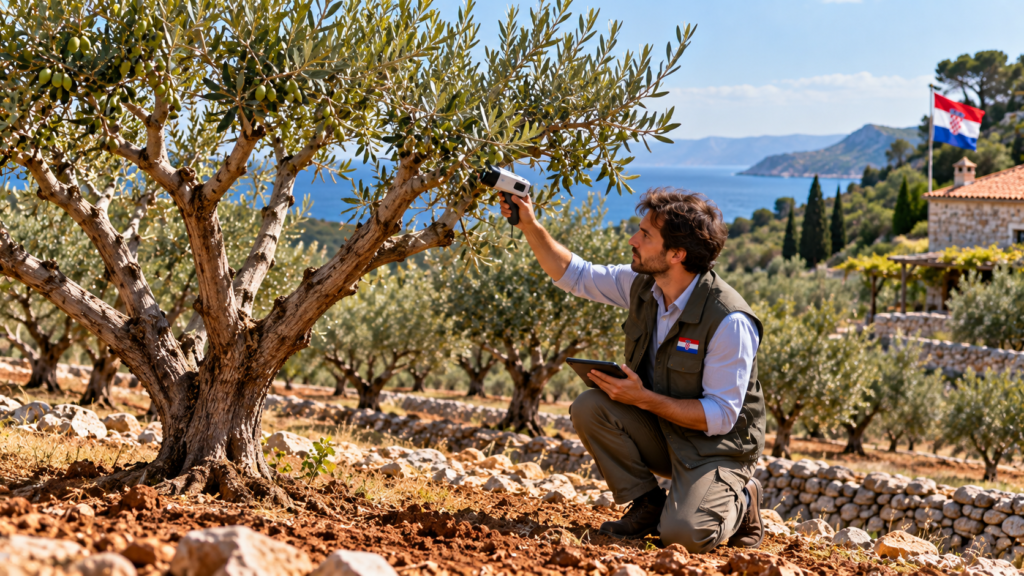
Heavily pruned olive trees accumulate oil in their fruit significantly faster than unpruned trees, according to a three-year field study by the University of Zadar in Croatia’s Dalmatia region. The research, part of the OLIVE-EduTech project, is giving growers and buyers new, measurable evidence for how canopy management shapes both yield and oil quality.
Three Years of Measurements in a Dalmatian Grove
The study is being carried out in an 18-hectare organic olive grove near Benkovac owned by Lecor, a company run by Branimir Lepur, where roughly 4,000 trees grow in shallow, rocky red soil at about 150 meters elevation. Three years ago, researchers led by agronomist Šime Marcelić of the university’s Department of Ecology, Agronomy and Aquaculture began reshaping selected trees into a polyconic vase — an open-canopy training system — and split the grove into light, moderate, and heavy pruning groups alongside an unpruned control. Using near-infrared spectroscopy and optical sensors, the team tracks oil content on a dry-matter basis throughout the season, a method that filters out the misleading swings in fresh-fruit oil percentage caused by drought or Dalmatia’s strong bora winds.
Heavy Pruning Nearly Doubled the Rate of Oil Buildup
“Measurements so far indicate that oil accumulates more rapidly in the fruit of heavily pruned olive trees than in fruit from unpruned and unirrigated trees,” Marcelić said, presenting the findings at a field day at the Lepur estate in September 2026. “In some comparisons, the difference in the change in oil content approaches twice the value.” Pruned trees also showed stronger shoot growth and a higher share of hermaphroditic flowers, an early indicator of fruit-set potential, while the more open canopy reduced the humidity that favors peacock spot, a common fungal disease. The trade-off is short-term: heavy reform pruning can depress yield for roughly three years, which is why some Dalmatian growers still hesitate to adopt it. Oils from the Lepur estate have measured polyphenol levels as high as 1,500 milligrams per kilogram, confirmed by the University of Split’s Faculty of Chemistry and Technology — a reminder that grove management, not just variety or harvest timing, drives the quality figures buyers rely on. For buyers sourcing Tunisian olive oil from vetted suppliers, this is a useful prompt to ask not only when and how a grove is harvested, but how it’s pruned — canopy management affects oil accumulation and polyphenol content well before the olives ever reach the mill.
Sponsored Placement
Reach international olive oil buyers and importers. Advertise your business right here.
FAQ
Does pruning olive trees increase their oil content?
Yes. A three-year University of Zadar study in Croatia found that olive trees given heavy “reform” pruning accumulated oil in their fruit faster than unpruned trees, with some comparisons showing the rate of oil-content change nearly double.
Why does an open olive tree canopy improve oil quality?
Opening the canopy through pruning lets more sunlight and air reach the leaves and fruit, which supports more efficient photosynthesis and oil synthesis while reducing the humid conditions that favor peacock spot, a common olive fungal disease.
Source: Olive Oil Times
Sponsored Placement
Reach international olive oil buyers and importers. Advertise your business right here.